Monday, May 17, 2010

Day 2 - Monday, May 17, 2010

Today was our first full day at Diné College. Several of the students got up just as the sun was rising and walked toward the east to greet the arriving day in the traditional Navajo way.

Sawyer Derry got a few great early morning photos:

We started the morning class by having all students introduce themselves in a traditional Navajo style giving their own name then the "clan" names of their parents and grandparents. Then we talked about the plans and goals for the two-week class.

We watched several of the documentary projects from last year's Navajo Oral History program. Prof. Miranda Haskie of Diné College gave us an overview of the history of Diné College.

Several students took photos to help give our readers a view of Diné College and it's campus.

(above photo of the Diné College Library, was taken by Ben Chambers from the 6th Floor of the Ned Hatathli Center.)

(This photo of the Diné College Hogan-shaped dorm buildings is by Robbie Christiano.)

Below are a few shots of the students walking across campus to lunch or back to class.

(above two photos by Ben Chambers)

(above two photos by Michael Ruka)

(above photo by Robbie Christiano)

We had lunch at the Diné College Snack Bar (photo by Sawyer Derry):

After Lunch we enjoyed a tour of the Ned Hatathli Museum at Diné College. Museum Director Alex Mitchell explained the value of the traditional Hogan in the education system. He explained several wall murals depicting Navajo Creation Stories, First Man and First Woman, the Four Worlds, and the Four Sacred Mountains. He showed us several other museum exhibits including wall murals of Navajo history, the pueblos of Dinetah (ancestral Navajo land) and pottery created by Navajos and pueblo people.

(above photo by Ben Chambers)

(above two photos by Sawyer Derry)

(above two photos by Robbie Christiano)

(above photo by Michael Ruka)

We stopped by Dr. Ferlin Clark's office, the President of Diné College. He spent about 45 minutes with our class talking about the importance of education, and how much he valued our Navajo Oral History project. He also gave an inspirational message that told the students how great their responsibility is to get the stories of the elders down accurately and with respect.

(above photo by Robbie Christiano)

To finish the class day, the students listened to short lectures on basic journalism techniques and visual communication basics. The WSU students have heard those lectures before, but it couldn't hurt for them to hear the details again ... and it was mostly new information for the Diné College students.

(above photo by Robbie Christiano)

(above photo by Sawyer Derry)

Ben Chambers and Jenn Westman made the family style dinner this evening: soft shell tacos and refried beans with tomatoes, lettuce and shredded cheese. Delicious.

After dinner, we went to a local event at the Tsaile-Wheatfields-BlackRock Chapter house called "Just Move it." The Navajo Health organization plans community walks across the nation inviting people to go on a three-mile hike. It's free to participate; it's a nice walking and talking social activity; and we got a free t-shirt just for participating. We all did it together, and it was fun ... but my knees are aching now ... and we have a several mile hike tomorrow (Tuesday) down into Canyon de Chelly.

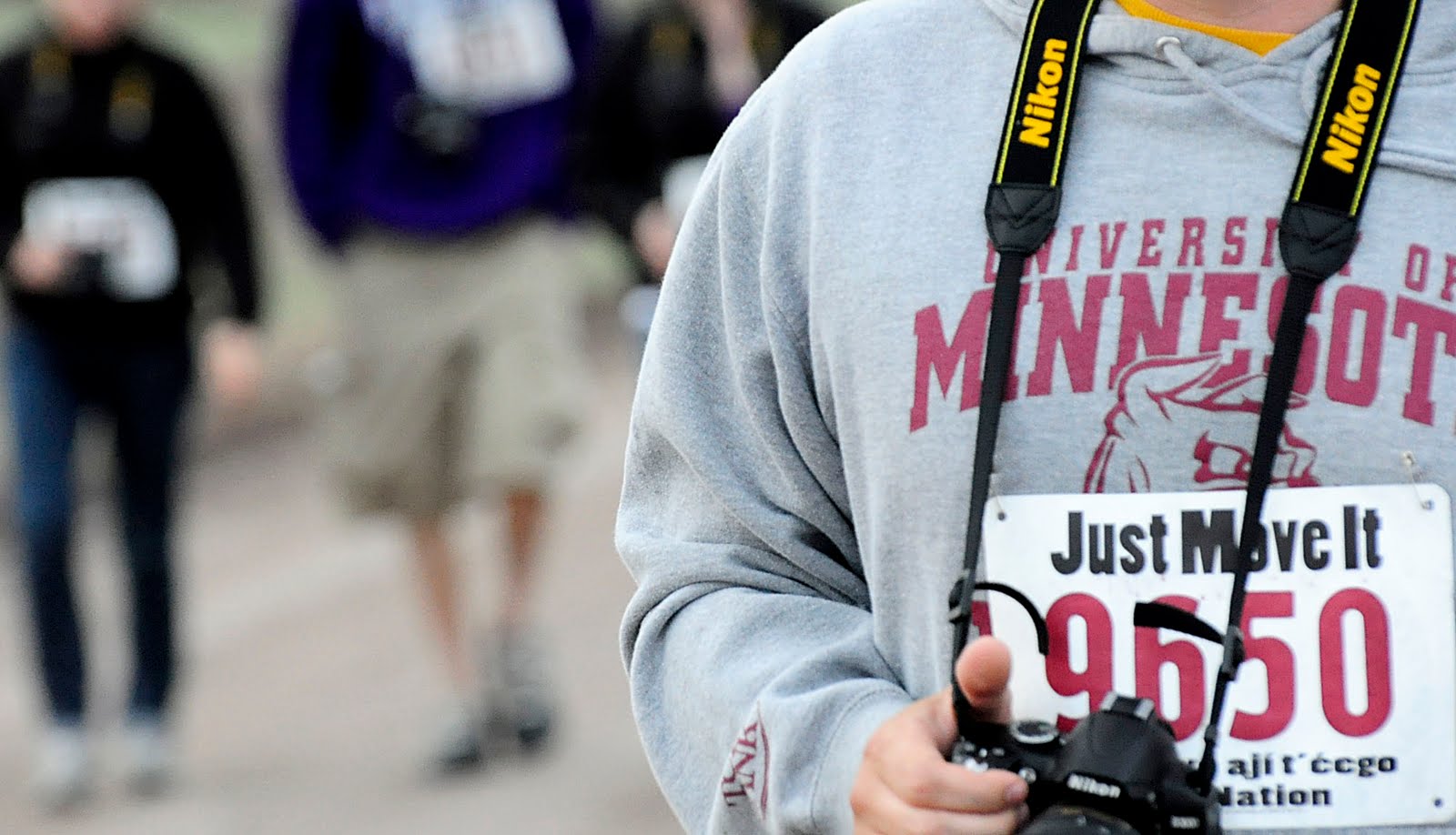

(above two photos by Robbie Christiano)


(above photo by Sawyer Derry)


(above photo by Michael Ruka)

The day ended with a nice sunset, and just as the day started, S
awyer Derry created beautiful images.


As always, unless otherwise noted, the photos are by me. As you can see, I didn't have to shoot very many pictures today, because all the photojournalists around me were doing a great job of recording visually the day's activities.

We hope you are enjoying reading this blog. The "comments" section is open and anyone can leave comments if they wish. We'd all love to hear what you think of the blog, the photos, the project, etc.

Thanks for reading. We're only one day in to the trip and we're learning a lot and already feeling like we're fitting into the culture a little.

-- Tom Grier

Sunday, May 16, 2010

Day 1 - Arriving on the Navajo Nation

Since I had less than two hours to drive to get to the Albuquerque airport this morning, I slept a little later than usual-- 7 a.m. local time-- and got on the road. I was tempted to take a side venture to visit the Puye Cliff Dwellings, which is the site of some ancient Anasazi ruins that I have never yet seen. Worried I might get carried away with hiking around there and then feel rushed getting to the airport, I skipped the cliff dwelling and stayed "on task."

Instead, I headed into a small town in central New Mexico, took another courthouse photo, then stopped at self-serve car wash and blasted some of the road dirt off the van. I drove to the Albuquerque Sunport International Airport and spent 30 minutes or so rearranging all the gear and luggage in the van so it would all fit, and there would be room for eight humans.

Wow, it was going to be a tight fit. Thankfully, it's a relatively short drive to the Navajo Nation; about 4 and a half hours.

I sat in the Sunport Terminal, used their free internet access, and watched the airplane's progress. Jenn Westman's United flight from Chicago to Albuquerque via Denver was reportedly on time, so I had only 45 minutes to wait. Then, the Delta flight from Minneapolis actually arrived about 15 minutes early, only about 15 minutes later. Than Jennifer's flight. Everything was progressing on schedule.

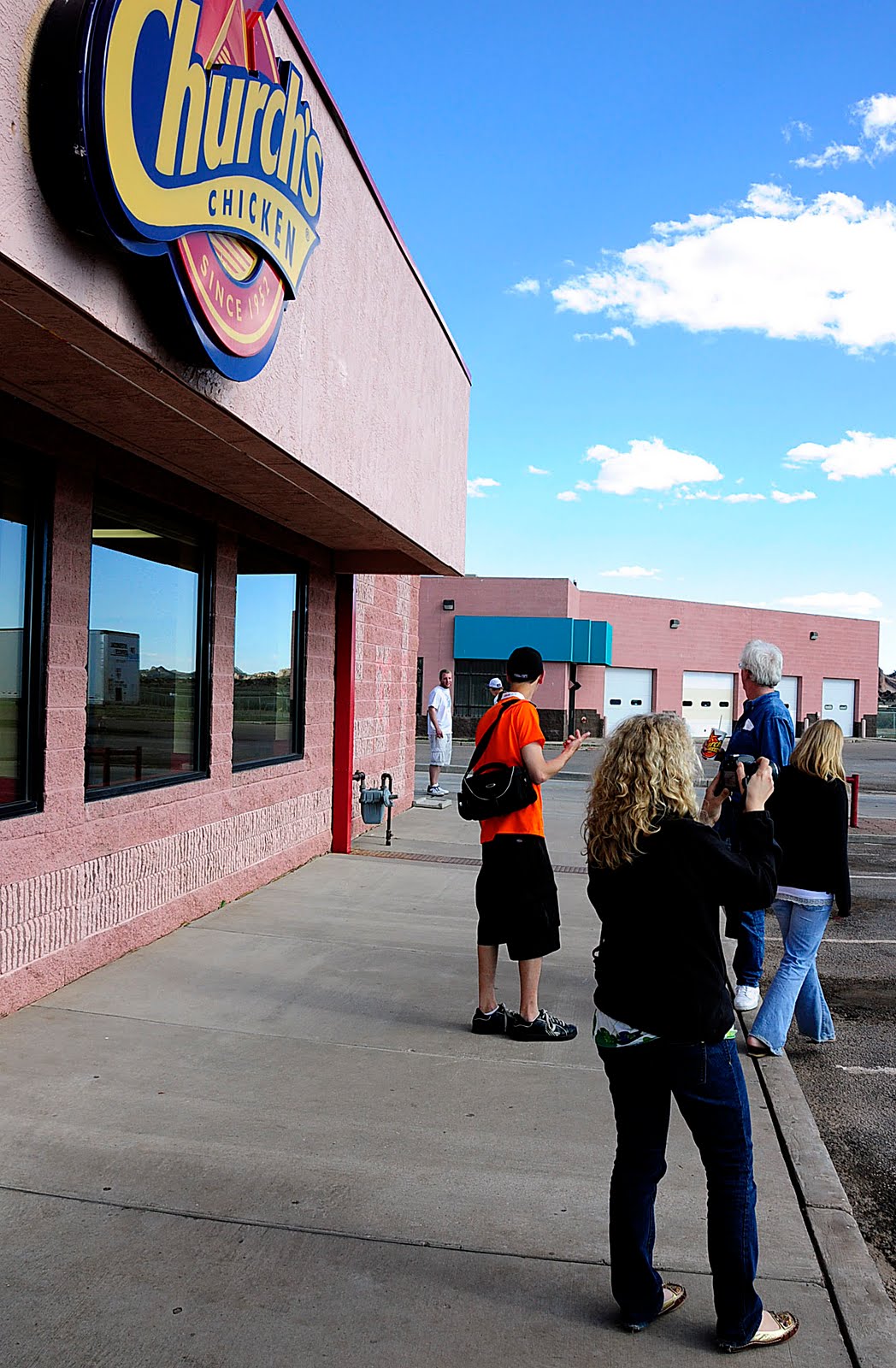
We packed the van to the gills, and headed on down the road. We stopped in Window Rock, on the Navajo Nation and ate a quick dinner at Church's Chicken then stopped at the grocery store for some goodies for breakfast tomorrow and the family style dinner that Jenn and Ben will make for us all tomorrow evening.

We when got to campus we got checked into our dorm rooms, then went for a walk all around campus. The sky is a beautiful blue and it was in the mid 60s when we started our walk. 40 minutes later it was starting to get quite cool.

Here's a group photo created by Brianna Klapperich with her Nikon camera and a remote trigger a few minutes after we arrived on the Diné College campus.

(Pictured left to right, back row: Michael Ruka, Sawyer Derry and Ben Chmabers; front row: Tom Grier, Kelly Sharatt, Jennifer Westman, Brianna Klapperich, and Robbie Christiano.)

Ben lit a fire in the fireplace that is at the center of our Hogan-shaped dorm building (A Hogan is a traditional Navajo dwelling and spiritual place that usually has eight sides.).

I've asked the students to take many candid shots throughout the next two weeks and share them with me so I can use many of them on the blog.

Above and Below are some photos from our first day together. Unless otherwise noted, all photos on the blog are by me -- Tom Grier.

We'll probably hit the sack early tonight and get ready for a full day of classes tomorrow.

-- Tom Grier

Here's some fun pictures shot by Sawyer Derry on the way to Diné College and right after we arrived on campus:


Now, here's a few more photos by Brianna Klapperich:


This last image by Brianna is of Bear Mountain. If you look close and think about it, you can see the rock is in the shape of a bear lying down, with his rear end at the left edge and his ear, head and snout facing right.

And here's a photo of Brianna, by Michael Ruka:

Saturday, May 15, 2010

Travel Day 3 - Southwest Into New Mexico

Another long day in the car driving the back roads of Colorado and New Mexico. I stopped in a few small towns to shoot pictures of their courthouses.

Out here, many of the counties were established in the late 1800s or early 1900s. Most of the courthouses I've seen in the past few days were built between 1910 and 1940. In many cases, the building that serves as a community's courthouse today is the second or sometimes third courthouse for the particular county.

Sadly, some of the buildings built in the 1950s or later are low rectangular buildings with less character than most elementary school buildings. Clearly, these were built to be functional and economical. In my mind, they totally miss the point of a courthouse being a central figure in the community; a place in which the pride of the community is manifested in a beautiful, interesting, well-maintained building.

In some communities, the building says, 'We're proud of our home and we're glad we live and work here. We gather at this central place in our town for meetings, music, and difficult decisions." In other communities, the building seems to say, "We're poor, and tired and running out of patience. We needed a building and we built the cheapest thing we could to fulfill the need." Kind of sad.

I haven’t uploaded pictures for a couple days, partly because the internet at the motels I'm staying in has been spotty and slow. If you're interested in checking out some of my courthouse pictures (and other images that contain "a sense of place") follow this link: http://www.panoramio.com/user/286133 or paste it into your web browser. This will lead to a collection of more than 200 images I've posted to Google Earth.

Tomorrow, I have about a 2 hour drive to Albuquerque where I will wait at the airport for the WSU students to arrive on two separate flights. Once they're safely on the ground, we'll begin a four hour drive to the Navajo Nation and to Diné College where we'll get settled in our residence hall rooms and get ready for our first class day tomorrow.

Keep checking this blog for updates throughout our two-week field work for the 2010 Navajo Oral History project.

-- Tom Grier, professor of Mass Communication

Winona State University

Friday, May 14, 2010

Travel Day 2 - Going South

I left South Dakota, and headed south into Nebraska, then Kansas, and then cut the corner into Colorado. About 550 miles of driving today. Of course, I followed mostly small highways and stopped to take some pictures of courthouses.

It was beautiful most of the day with blue skies, sunshine, and about 70 degrees. Toward evening, I could see clouds moving in from the west and the temperature started dropping. Some thunderstorms are moving across central Colorado tonight and tomorrow. I'm in the middle part of eastern Colorado and figure about 9 hours to Albuquerque tomorrow, crossing into New Mexico via the Raton Pass.

I talked to a couple I met this evening in a motel lobby who said they had just driven north through Wolf Creek pass and had some rain, but the temp. stayed above 50, so there was no snow or sleet. This is good news. I've driven through these mountain passes many times, and frequently have encountered snow and slippery driving ... even in what would normally be considered warmer weather.

Some people-- both on the road and back home-- have said they thought I was crazy to do all this driving myself. Actually, I kind of like it. To be honest, I'd rather be traveling with my wife, Julie, so we could explore different places together. But, since it's unrealistic for her to get off work for this long, I just loaded up my iPod with great music, and brought along about 8 or 9 books on CD.

Yesterday morning, as I headed out, I listened to Dayton Duncan and Ken Burns read "Horatio's Drive," about the first cross-continental automobile drive. I love Duncan's writing and it seemed fitting to listen to the many mishaps Horatio Nelson Jackson endured in 1913 while driving an early motorcar from San Francisco to New York City. That trip took 62 days. I'm thankful my drive is quite a bit shorter, and that I have a much more reliable set of wheels.

Later in the day yesterday, while crossing South Dakota, I was listening to Larry McMurtry's biography of Crazy Horse. Very well written and thoughtful and I learned a lot about one of the Sioux Indian's most famous warriors.

Today, I enjoyed Tim Russert's "Wisdom of Our Fathers." In it, he shares personal stories of his father, Big Russ (an expansion of what he wrote in his first book, "Big Russ and Me"), and stories of parenting his son, Luke. The book mostly contains individual stories that thousands of people sent to Russert after reading his first book.

As I listened, I thought a lot about my own Father, Don Grier, who has been gone from this planet for more than nine years. I still miss him terribly. I also thought about my son, Jeffrey, and my daughter, Jennifer, and how I hope I have been a good father to them. I got teary-eyed several times while listening to the stories in this book. Feeling the emotion was good, but the tears were interfering with my ability to see the road!

Next, I popped in a Tony Hillerman novel featuring Navajo Police Lieutenant Joe Leaphorn. Some of my Navajo friends don't particularly value Hillerman's writing as accurately portraying Navajo culture or lifestyle. I read him for enjoyment. The stories are engaging, and Hillerman include lots of references to communities and landmarks on that Navajo Nation with which I'm familiar.

Well, this blog post has gotten a bit off track from where it started. I'm on my way to the Navajo Nation to help a group of Winona State University and Diné College students work together to do in-depth journalism projects on Navajo elders. By the time I get there, I'll be ready to be out from behind the wheel.

Thanks for reading ... more to come.

-- Tom Grier, professor of Mass Communication
Winona State University

Thursday, May 13, 2010

Travel Day 1 - Heading West

The van was loaded yesterday with all the gear we need for our Navajo Oral History project documentaries and today (Thursday, May 13, 2010), I hit the road heading west.

I drove out of Winona on I-90, and literally within one mile of getting on the Interstate, it started raining, and the highway was down to one lane due to road construction. The orange road construction barriers continued for many miles, and the rain continued for almost the entire time I was on the road today. There were a couple short respites from the rain, but they were brief.

Along the route, I made a few stops to photograph some beautiful old courthouses in some small towns. I've long had an interest in the stately old courthouses that serve as a real centerpiece for many communities.

Faribault County Courthouse - Blue Earth, Minn.


Martin County Courthouse - Fairmont, Minn.


Pipestone County Courthouse - Pipestone, Minn.


For the past few years, whenever I travel, I try to get off the four-lane freeways and follow the smaller U.S. and state highways into county seats, watching for their courthouses. Then I walk around the courthouse looking for the best angle to photograph the building. Once in awhile a local police officer or sheriff's deputy will stop and ask what I'm doing. I suppose it can look odd to see a guy like me carrying a backpack around a courthouse, and sometimes lurking in bushes or laying in a street. Once I explain that I'm a college professor who teaches photography, and that I just enjoy taking pictures of great old buildings, they smile and let me go about my business.

I've upload many of my courthouse images -- and other roadside oddities that catch my interest -- to Google Earth. More than 200 of my images have been placed in the Google Earth mapping system.

Today, In addition to several courthouses in Minnesota and South Dakota, I got a nice photo of a huge Green Giant statue in Blue Earth, Minn.

I stopped for the night in the middle of South Dakota, and plan to head south into Nebraska tomorrow.

All of this travel is fun and interesting, and I'm learning from books on CD while I drive. It's all preamble to the important work the Winona State University and Diné College students will do beginning next week on the Navajo Nation.

Final Class Day Prior to Field Work

Today (Wednesday, May 12, 2010) was the third and final day of Pre-Travel classes for the 2010 Navajo Oral History Project for Winona State University students.

The seven WSU participants had three days of classes to learn something about Navajo culture, to review journalism and visual journalism principles, and to learn or re-learn the audio, video and still photography equipment. In addition, the students used class time to get to know each other and to learn as much as they could about the Navajo Nation that will be their home for the next two weeks.

The students, in groups, researched a category of life on the Navajo Nation, and prepared a presentation during which they educated their classmates (and faculty) about things like: education, law enforcement, healthcare, government, judicial system, and basic demographic information about the Navajo Nation. They made their presentations today to help us all be a little bit better prepared for our time on "the rez."

Right after class, the students assembled their luggage and camping gear and stowed it in the van I'll be driving to Arizona. The students fly to Albuquerque on Sunday where I'll meet them at the airport.


I'm looking forward to a great trip that will meet and exceed our main goals:

Foster partnerships between students

• Experience a different culture

• Develop skills and abilities

• Inform and educate the public

• Create quality portfolio pieces

• Travel, Learn, Have Fun


The students assure me they are serious about two things:

- Doing meaningful journalism that will stand the test of time; and

- Having fun!


I'll update this blog as often as I can to keep you informed of our activities. Thanks for reading.


(Unless otherwise noted, all photos on this blog are by me. Once we are in the field and the students are shooting more, I try to use student-created images whenever possible.)

-- Tom Grier, professor of Mass Communication, Winona State University

Tuesday, May 11, 2010

Preparing For Field Work

The 2010 Navajo Oral History program students met again today (Tuesday, May 11, 2010) to talk more about the documentary journalism projects they will begin next week.

During the class, we talked more about the Navajo reservation, and the way people live there. We watched a program called 30 Days: Life on the Navajo Reservation in which Morgan Spurlock lived with a Navajo family for a month. By the end of the month Spurlock had developed a love and respect for the Navajo culture.

For the last hour of class, we reviewed the operation of the audio, photography and video gear that will be a part of the journey and that will help us record the life stories of the elders. Prof. Robin O'Callaghan of the Winona State University Mass Communication department, visited our class and helped the students learn how to correctly use the video production gear.


We have one more day of class this week, then we'll load a van and head to the Navajo Nation to meet our Diné College counterparts and begin our projects.

-- Tom Grier
Winona State University